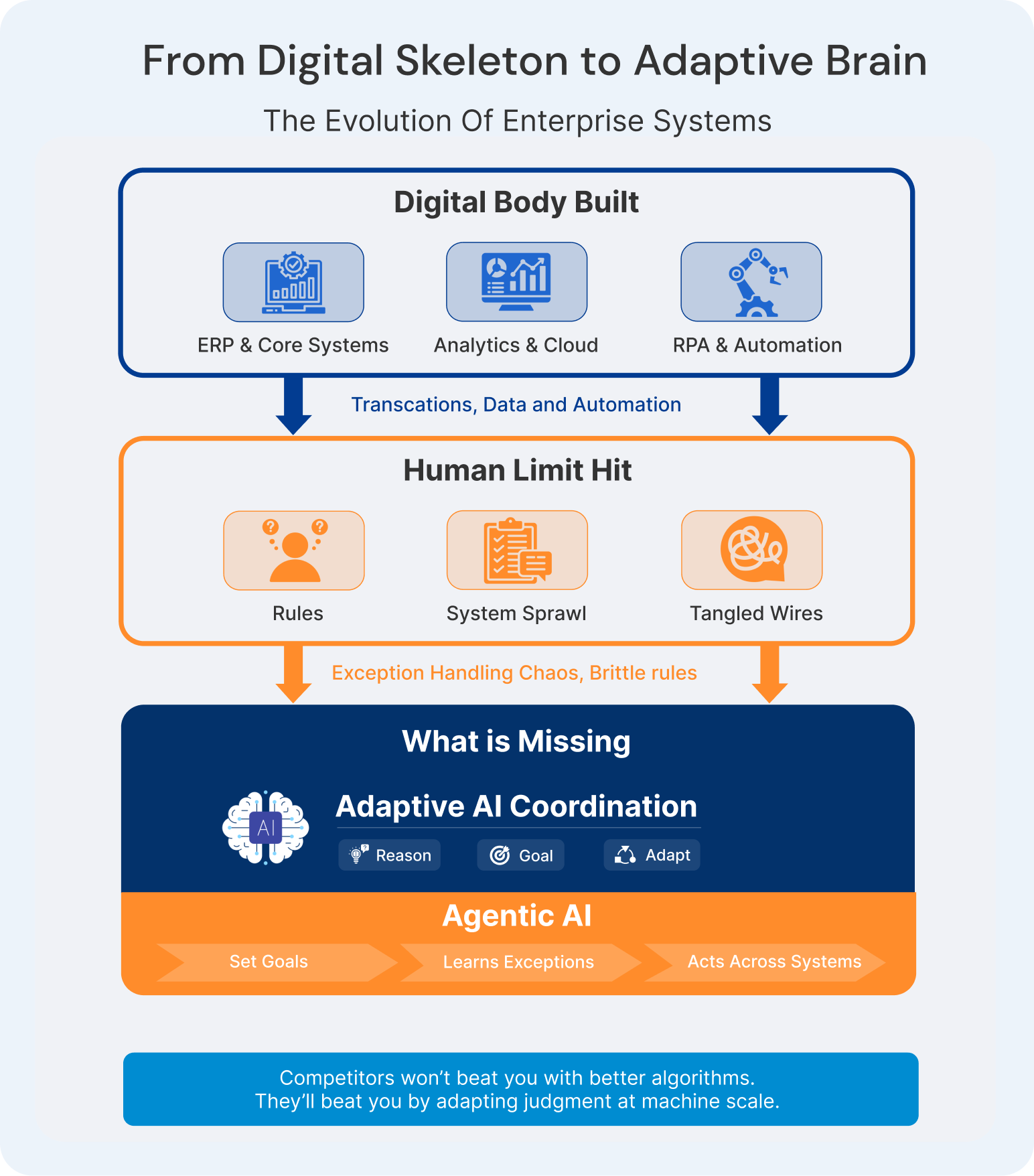
From Digital Skeleton to Adaptable Digital Enterprise: The six decades of Enterprise’s Technology Transformations (My Worldview)
For more than six decades, enterprises have invested heavily in technology to become digital. These investments have driven efficiency, reduced risk, enabled scale, delivered differentiated experiences, and allowed organizations to compete globally.
And yet, a familiar concern continues to surface in CXO conversations:
“Enterprises are more digital than ever — yet they still struggle to adapt quickly to changing customer expectations, regulations, and geopolitical disruptions.”
The world continues to accelerate, while enterprises seem perpetually in a state of catch-up.
This blog is my attempt to answer two fundamental questions:
As Confucius famously said, “Study the past if you would define the future.” The same principle applies to enterprise technology.
To understand what must come next, we must first understand how enterprises arrived at the current state — and why even the most digitally advanced organizations remain constrained by human limits in how work is coordinated and decisions are executed.
From there, I will outline how Human + AI, working together, can define the future of digital operations.
Agentic AI is not another technology layer to be added to the stack. It represents an architectural shift — a missing control layer that enables enterprises to become truly adaptive.
If implemented correctly, Agentic AI allows enterprises to evolve into living digital twins — systems that sense their environment, reason over change, and adapt continuously.
This is not a tooling decision.
It is an operating model decision — about how judgment, intelligence, and execution flow through the enterprise.
In an Agentic AI–enabled enterprise:
Together, they form a digital operational fabric that continuously senses change, compounds learning in real time, and autonomously reconfigures operations within defined guardrails.
The earliest enterprises were structured and orderly — but only to the limits of human capacity.
Back to when it all began: the 1960s. Picture an enterprise at that time. Manufacturing teams are gathered around whiteboards, frantically scribbling production schedules with dry-erase markers that keep drying out. Finance clerks are hunched over massive paper ledgers, pencils in hand, totaling columns manually while hoping they don't make arithmetic errors. HR maintains endless filing cabinets stuffed with employee records, where a single address change requires hours of manual cross-referencing.
If you think today is complex, will you say that enterprises in yesteryear were chaotic? Unscalable? I think you would agree that they were scalable & orderly- but only to the limit of human capacity.
This was the environment in which Material Requirements Planning (MRP) systems first emerged. Manufacturers needed a way to control inventory complexity and spiraling costs. MRP systems brought structure by calculating what materials were required, in what quantities, and when. During the 1970s, these systems evolved into MRP II, extending beyond inventory to include production scheduling and capacity planning.
By the 1990s came the ERP revolution. Gartner coined the term, and companies like SAP, Oracle, MFG/PRO, Baan, Lawson, JD Edwards, and PeopleSoft transformed the enterprise systems landscape. These weren't just digitization tools but also the systems that drove standardization of both processes and data. Manufacturing, Finance, HR, Sales: almost every critical process and transaction got standardized and structured. Simultaneously, during the same timeframe, banks built core banking systems, insurers created policy platforms, retailers deployed merchandise management systems and almost every other industry created its systems of records and transactions.
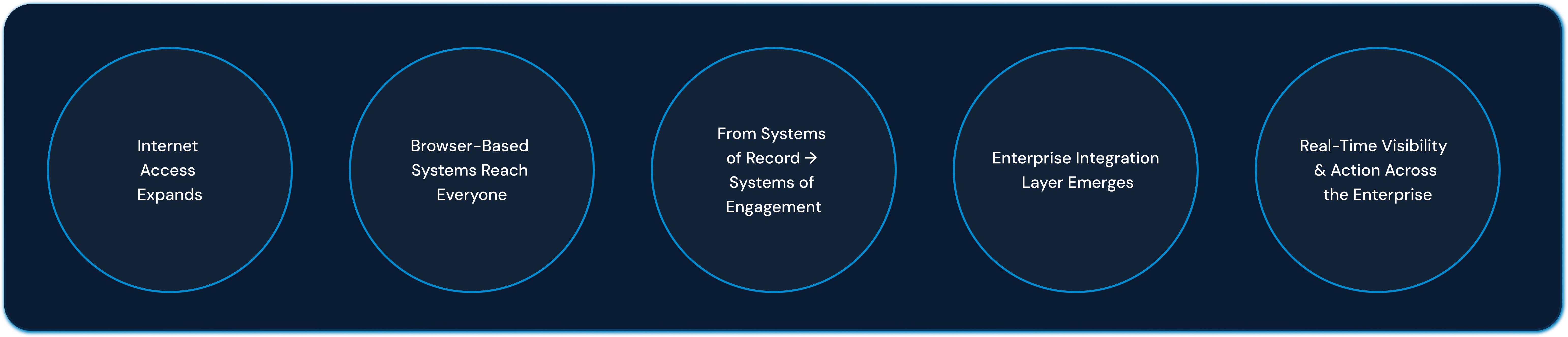
Internet landed and world expanded: From internal transactional systems to systems of engagement
Then, the internet arrived. Suddenly, transactional systems trapped behind departmental firewalls weren't isolated anymore and information/actions weren't restricted to certain departmental power users. Browser-based access meant any employee could reach the system to extract information. Executives could approve expenses from hotel rooms; suppliers gained real-time visibility into demand; customers could finally track orders themselves.
What began as internal systems to service internal employees expanded to service the customers & end consumers. Enterprises weren't just serving employees—they were building eCommerce platforms and omnichannel experiences to serve consumers directly. To achieve this, enterprises also invested in enterprise application integration layers—the nervous system—connecting CRM data to ERP inventory to shipping. Every corner of the enterprise became accessible.
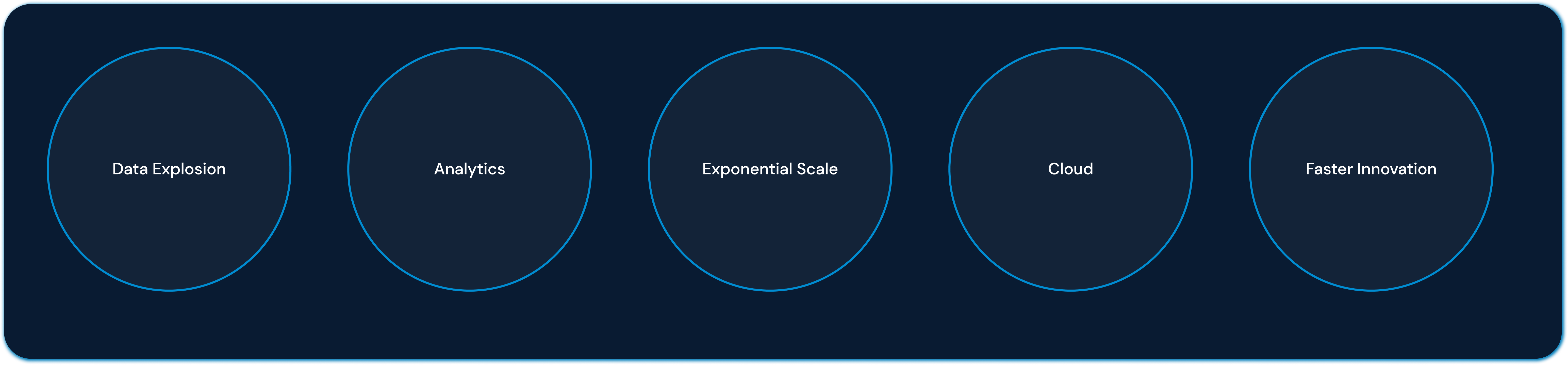
Analytics gave enterprises the ability to see patterns and insights at scale, while cloud provided the elastic infrastructure to sense faster, scale infinitely, and innovate at internet speed.
But accessibility alone wasn’t enough to win the war. By the mid-2000s, enterprises needed something more: better sensing—vision. While mobile commerce exploded, social platforms like Facebook and Twitter also created massive data streams. Customers weren't just transactional entities anymore; they had preferences, behaviors, and sentiments. Big Data Analytics gave organizations eyes to see beyond their four walls. Hadoop clusters crunched petabytes, and Tableau/PowerBI dashboards, along with ML models, revealed patterns humans could never notice naturally.
During this period, user counts didn't just grow linearly—they skyrocketed. Data volumes went exponential. Cloud computing stepped in to provide the muscles for digital enterprises. AWS and others didn't just sell servers; they provided the strength to bear this unprecedented, internet scale load. Unlimited infrastructure flexibility meant enterprises could handle millions of daily transactions and also escape the tyranny of hardware refresh cycles every 3-5 years. With cloud, enterprises could experiment with new pricing models, launch new products as a service, and iterate at unprecedented velocity.
Visibility, scale improved dramatically, innovation cycles shortened but decision-making remained largely human-driven
Automation and RPA scaled speed and efficiency by executing repetitive tasks at machine pace, but remained brittle—amplifying execution without judgment.
But with great scale came drudgery. Around 2015, enterprises started addressing a new challenge: repetition. Support agents answering the same password reset requests 500 times a day. Finance teams keying invoice data for thousands of customers. Automation (specifically RPA) emerged as the solution—the reflexes for the digital enterprises. Bots tirelessly clicked through APIs, eliminated keystrokes, and processed invoices 24/7. Fast. Automatic. Tireless.
Amplified productivity of human actions and efficient enterprise operations. It scaled efficiency, not judgment and drove cost down, however, when exceptions dominated, costs quietly returned—through humans
But reflexes aren't intelligent and don't learn how to self-adapt. These bots were brittle. One UI change in Salesforce? Every invoice bot broke. One regional holiday exception? The entire scheduling army failed. Enterprises needed humans constantly babysitting this digital workforce, endlessly writing rules for every exception.
While your ERP handles transactions, your CRM knows your customers, and your cloud supports internet-scale operations—who coordinates? Who reasons across exceptions? Who makes judgment calls when systems conflict? This is what keeps humans in digital enterprises awake at night. This is not a tooling gap—it is a structural limitation of rule-based systems which is challenging human limits.
Now it's 2026. The stakes for the enterprises are higher than ever before.
Globalization today demands hyper-local compliance instead of one-size-fits-all models. Enterprises face fast-evolving regulations like India's DPDP Act and the EU's DORA. Every country demands unique compliance, and the world is becoming more volatile. China's trade & data restrictions, US tariffs. Governments in every country vow to decrease complexity, but I believe it will only get messier as every nation protects its interests.
System sprawl compounds the challenge. Six decades of evolution has left enterprises with hundreds of applications. SAP runs manufacturing; Oracle handles Treasury; Salesforce owns the customer; ServiceNow keeps IT ticking. Each speaks its own language. RPA bots execute flawlessly within
The very employees you wanted to empower are drowning in a spaghetti of complexity. Humans have to be "always-on" exception handlers, to bridge the gaps rigid software cannot.
From Rules to Goals: Agentic AI shifts enterprises from predefined behavior to adaptive execution
To compete for the future, enterprises need more than rigid rules—they need adaptability i.e. ability to ReAct (Reason & Act) based on learnings/feedbacks & goals from humans. Enterprises have built a digital body, sensors that allow them to see, reflexes that allow them to act and muscles through which they can scale out, but all these systems are very brittle. They break the moment the world changes (or deviates from their normal conditions). This is where Agentic AI in my opinion can change the game.
By Agentic AI, I do not mean autonomous systems operating without oversight. I mean goal-driven AI agents that operate within enterprise guardrails, using existing systems, policies, and human feedback.
Until now, every system enterprises built was Deterministic. It followed strict rules: “If A happens, do B.”
Agentic AI introduces Goal-Based ability to ReAct (Reason & Act). These systems don't necessarily just follow a script, but they are assigned goals which are business outcomes. Instead of writing a 1,000-line script to handle a shipping delay, you can give these AI Agents a goal: “Ensure the customer gets their order on time, but don’t spend more than $50 extra on shipping unless they are a VIP.”
These agents then use the digital body built over decades:
No human wrote a rule for "Storm in Chennai." The Agent adapted to the situation using the tools available in the digital enterprise to achieve the goal “Ensure the customer gets their order on time…shipping unless they are a VIP”
Agentic AI implementation in a digital enterprise, also learns from your human experts during exceptions. Your experts can transform from being just exception handlers into teachers, and they guide the digital workers: When a human expert tells an agent—"No, for this non-VIP client also, prioritize shipping timelines over the shipping cost as it is a possible churn"—the AI Agent learns. AI Agent doesn't need an expensive computer code update but just normal natural language feedback and it adapts based on human guidance & feedback so that it can do it right next time…just like a human would.
These AI agents can go even further. Imagine an agent called IT Strategist whose goal is to identify and fix IT system gaps that create enterprise-wide inefficiencies. This agent notices that “Chennai storms” are becoming more frequent and uses its reasoning skills to design a systemic response. The IT Strategist agent can invoke a “Coding Agent”, pass enough context and business requirements via prompts to generate a script that “finds impacted VIP orders and reroutes fulfillment to an appropriate alternate warehouse”. Many enterprises are already experimenting with ‘coding agents’ that submit pull requests, fix code, run tests, and operationalize it post human approvals.
As highlighted in a hypothetical situation above, in a truly Agentic AI enterprise, agents don't just execute tasks to defined goals, handle the exceptions as per human guidance, but, with other Agents coordination, they can also permanently heal the digital systems of an enterprise. The digital enterprise system now "evolves" its own code in real-time, with humans in control.
Agentic AI thus turns your human experts from exception handlers into controllers & teachers, who set the goals & guide the digital workers, so that digital workers scale their human counterparts' judgement of reasoning & action, beyond just their clicks as in the past.
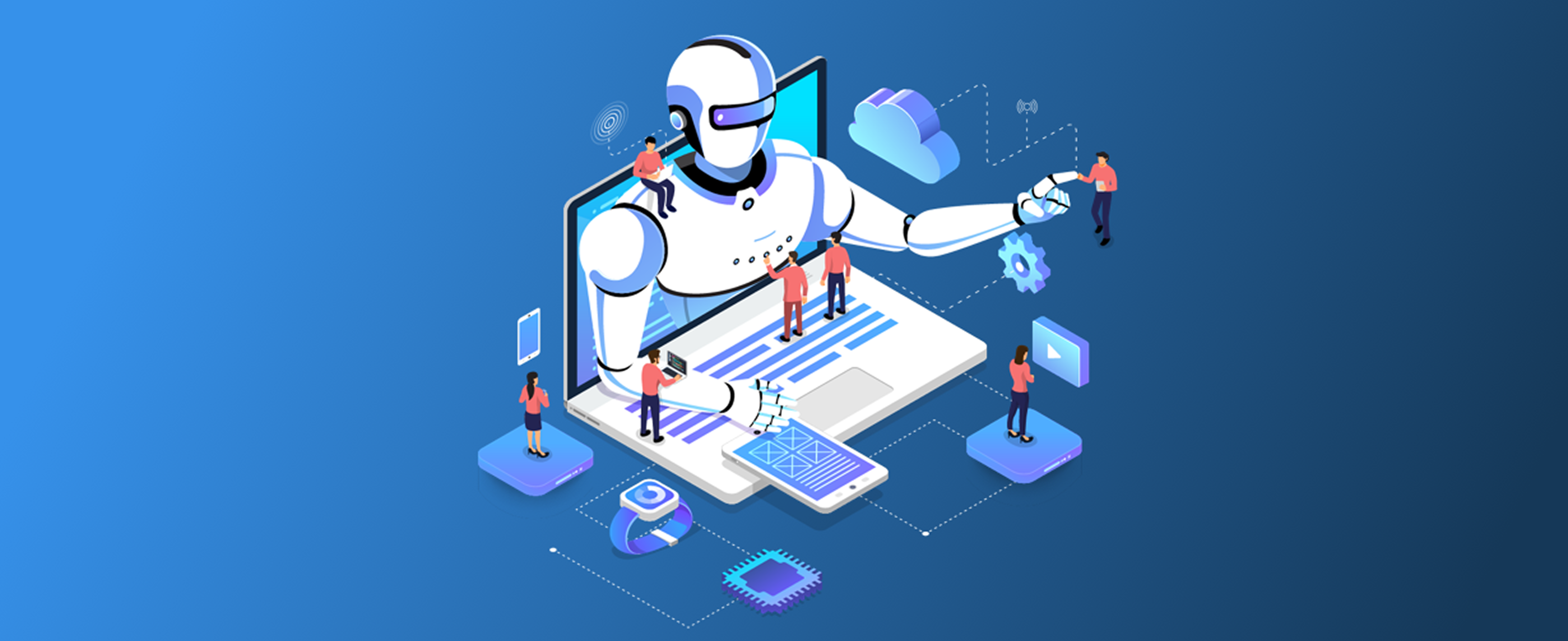
Agentic AI does not replace decades of enterprise technology investment—it completes them by enabling existing systems to reason, adapt, and evolve together under change.
Enterprises have spent decades building the digital body, and Agentic AI finally can provide the ReAct (Reason & Act) and ability to learn dynamically in real-life situations. It transforms a digital skeleton to a true Digital Twin, living, adapting and evolving to its environment changes.
To me, Agentic AI doesn't replace 60+ years of technology investment, but it unlocks it and is the natural continuum of the digital evolution:
Agentic AI is the architectural layer that allows previous investments to work together adaptively. Agentic AI—amplifies human performance by stripping away the drudgery of coordination, allowing humans to focus on creation.
The enterprise that began as whiteboards and paper ledgers can finally become a living, thinking, evolving digital twin which self-adapts to its environment—guided by human wisdom, but executed by machine precision.
“Enterprises don’t need more systems. They need a way for existing systems to reason together under change”
Join leading organizations using Pramey to deploy AI with confidence. No hallucinations. Full control. Built for enterprise.
 Exit
Exit
 Book a demo